

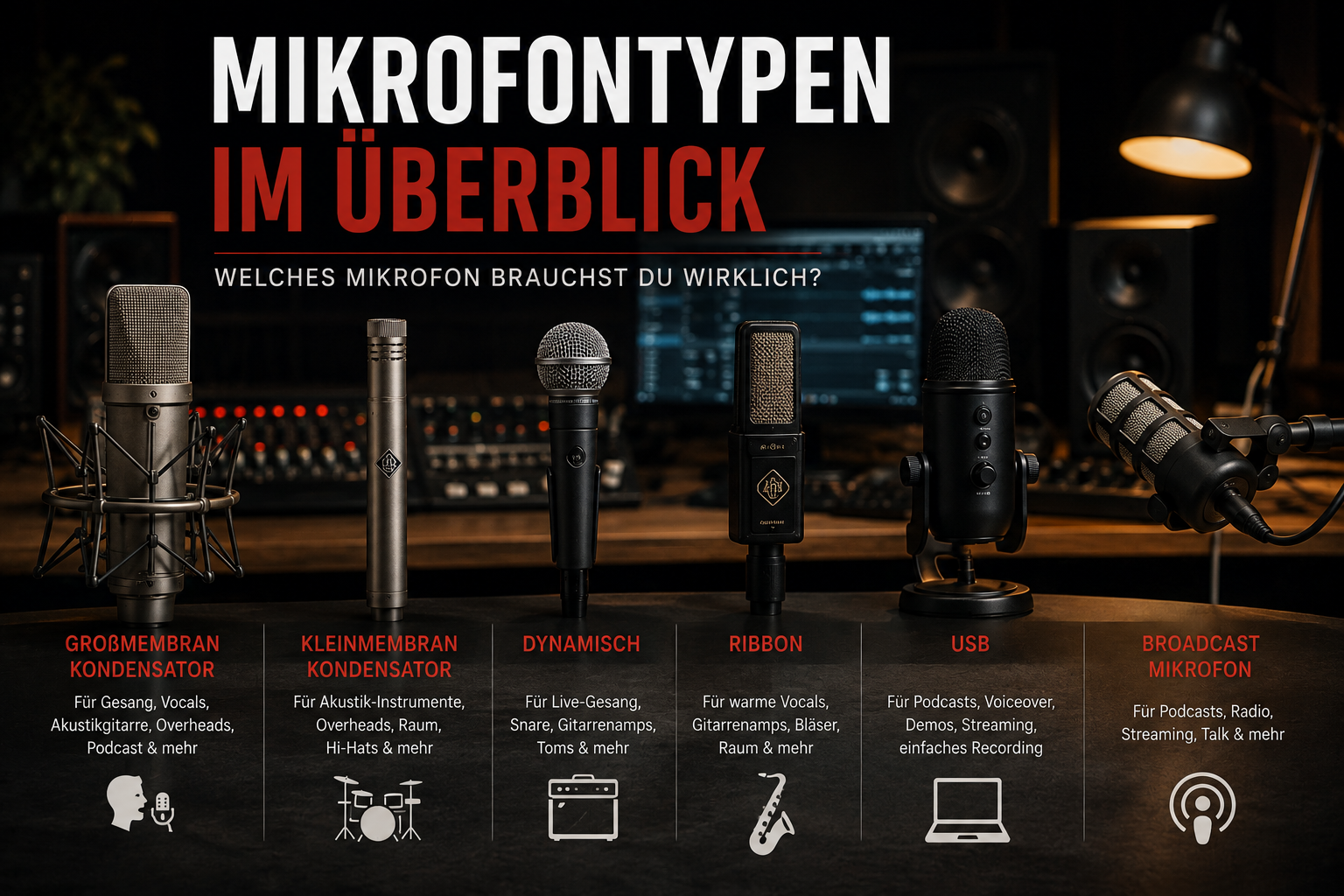
A good microphone is the heart of every strong live or studio performance. But do you actually know how the different microphone types differ – and which one suits your sound?
Whether you make music full-time or are just starting out with producing: choosing the right microphone has a huge impact on your audio quality. That's why the OneCrewRecords team has put together the most important facts every artist should know.
Which microphone suits your music?
The right microphone depends above all on what you want to use it for: live performances, recordings in your home studio, or capturing vocals or instruments as naturally as possible. Your budget and your personal recording style also play a role.
Ideally, a different microphone type suits each of these purposes. So it's worth knowing the differences before you invest.
The three most important types of microphones
As a musician, you'll usually come across three basic types:
- Dynamic microphones
- Condenser microphones (large diaphragm and small diaphragm)
- Ribbon microphones
Let's take a closer look at the three types.
Dynamic microphone – the all-rounder for the stage
Best suited for: live vocals
You'll probably encounter dynamic microphones most often when you perform live. They're considered especially robust, durable and versatile.
Technically, they work with a diaphragm, a coil and a magnet: when a sound wave hits the diaphragm, it vibrates and moves the voice coil in the magnetic field. This creates an electric current that transmits the sound.
Because dynamic microphones can handle high sound pressure without distortion, they're the first choice for live vocals, drum recordings and other loud instruments. Another advantage: they don't need an external power supply and are usually much cheaper than condenser microphones – ideal for artists with a smaller budget.
Recommended dynamic microphones
- Shure SM58 – the classic among live microphones, extremely robust and with a very reliable sound. A true industry standard.
- Sennheiser e835 – known for clear sound projection on large stages, while being comparatively affordable.
- AKG D5 – used worldwide by lead and backing vocalists to deliver clear vocals even with a lot of ambient noise.
Condenser microphone – the first choice for the studio
Best suited for: vocal recordings
Condenser microphones stand out with especially high audio quality and fine sound sensitivity. Instead of a coil and a magnet, they use a thin diaphragm and a capacitor principle to convert sound into electrical signals.
Because they respond to sound in an extremely nuanced way, you'll find condenser microphones mainly in recording studios – perfect for vocal recordings and acoustic instruments.
Within this category, a distinction is made between large-diaphragm and small-diaphragm condenser microphones. Large-diaphragm microphones are often used for studio vocals and acoustic instruments, as they reproduce a wide frequency range in great detail. Small-diaphragm microphones, on the other hand, are particularly well suited to instruments such as violin or acoustic guitar, where maximum clarity is required.
An important difference from dynamic microphones: condenser microphones need a power source, usually batteries or phantom power.
Recommended condenser microphones
- Neumann U87 – the gold standard in professional studios, versatile for vocals and instruments.
- AKG C414 – versatile studio microphone, known for exceptional sound clarity and fidelity to detail.
- Rode NT1 – popular entry-level model with a very transparent sound, ideal for quiet recording environments.
Ribbon microphone – the insider tip for a warm sound
Best suited for: recording a wide variety of instruments
Ribbon microphones are less common, but they impress with a classic, warm sound character and can be used for almost any instrument. They're often used to record several voices or instruments at the same time.
Technically, the principle is based on a thin metal ribbon that vibrates in a magnetic field. Ribbon microphones are excellent for vocals and acoustic instruments, but they're more delicate to handle than dynamic or condenser microphones – which is why they belong in a home studio rather than on tour.
Typical uses include vocals, acoustic instruments, piano and percussion. If you're looking for a natural, classic sound, you should consider a ribbon microphone.
Recommended ribbon microphones
- Beyerdynamic M160 – with a unique double-ribbon design for more sensitivity and an extended frequency response, often used for electric guitar and drums.
- MXL R144 – versatile for brass, vocals and guitar.
- Coles 4038 – iconic studio microphone with a smooth, natural sound, especially popular for orchestral recordings.
Which microphone is best for you?
If you're recording vocals, a high-quality condenser microphone is almost always the best starting point – a model like the Neumann U87 takes your voice to a whole new level sonically.
Are you more focused on coming across convincingly at live performances? Then a tried-and-tested dynamic microphone like the Shure SM58 is usually the right choice.
Do you record several instruments at the same time within one session? Then a ribbon microphone might be worth it.
Tip from OneCrewRecords: Feel free to combine different microphone types. If you use several microphones when recording, you'll have much more flexibility during mixing and mastering than if you only use a single microphone.
With the huge selection of good dynamic, condenser and ribbon microphones available today, it's really hard to go wrong. Still, it's worth choosing specifically according to your purpose – especially if you want to focus on a particular type of recording or performance.
Conclusion
Whether it's a dynamic, condenser or ribbon microphone: what matters in the end is that the microphone fits your purpose, your budget and your recording environment. Weigh up your individual requirements carefully – with the right microphone, you'll get much more out of your music sonically.
Do you have your equipment together and your next recording is done? Then OneCrewRecords is happy to support you with the next step: from professional release to distribution on all relevant streaming platforms.
Which microphone type do you use most often – and for what? Feel free to write to us!

Kommentare
No comments yet. Be the first!